MeloLingua turns your interests and daily life into stories at your level, then guides you through narration, vocabulary, and speaking practice.


Browsing a free story?Keep reading without an account. The app adds a personalized daily path, guided speaking, and progress tracking.
See what the app adds ↓Made for your world
Tell MeloLingua what you care about. Your interests become level-matched scenes you can read, hear, and practice aloud.
The preview uses sample variations. Your app story is personalized in full.
Story preview
Try your own idea
One connected session
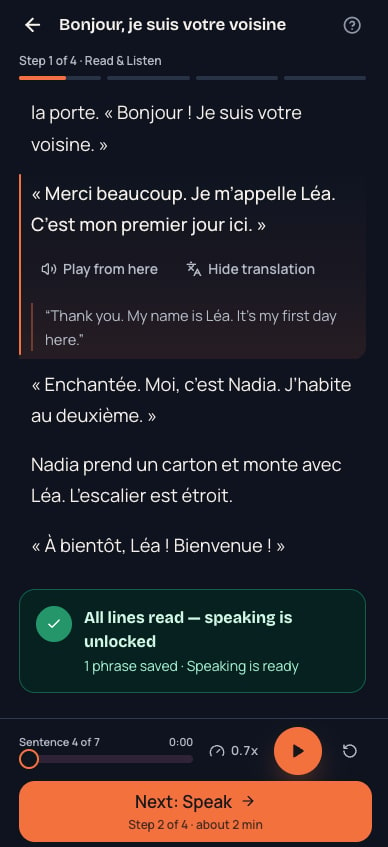
Follow a short, level-matched scene with natural audio.
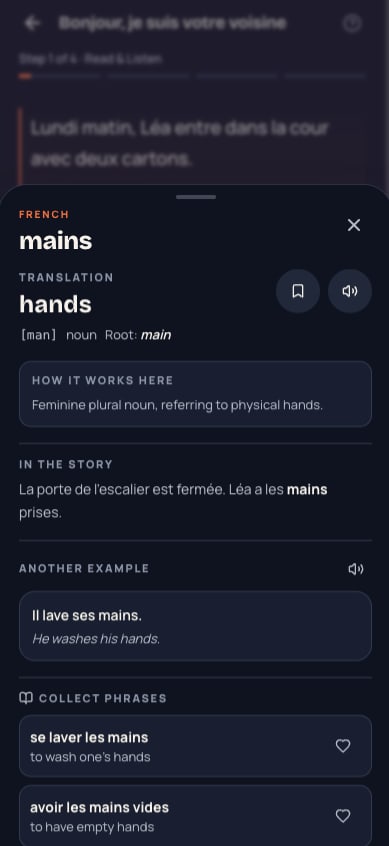
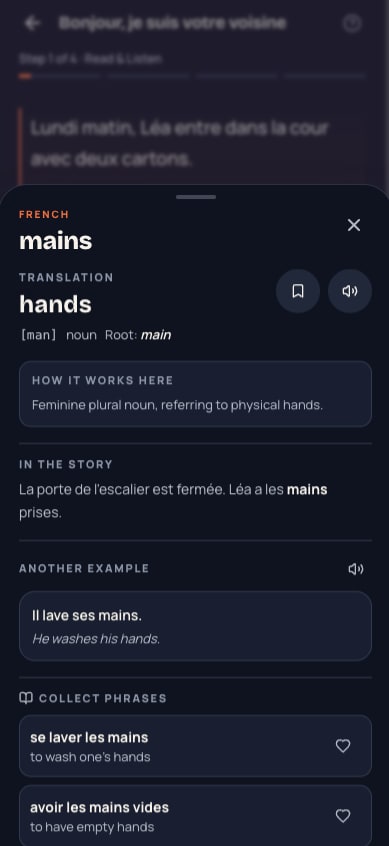
Tap unfamiliar words without leaving the story.
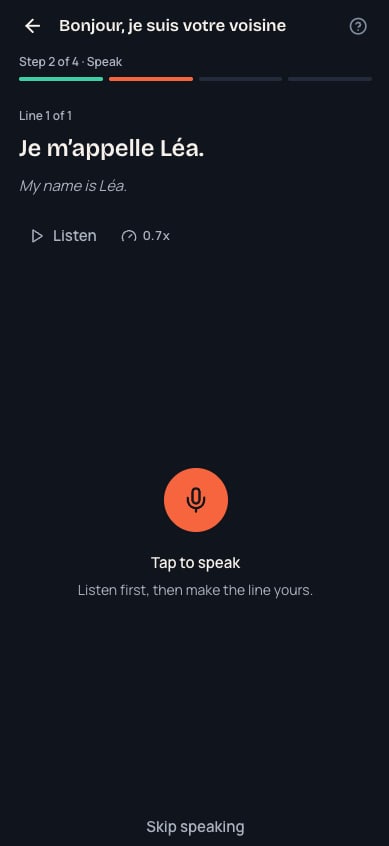
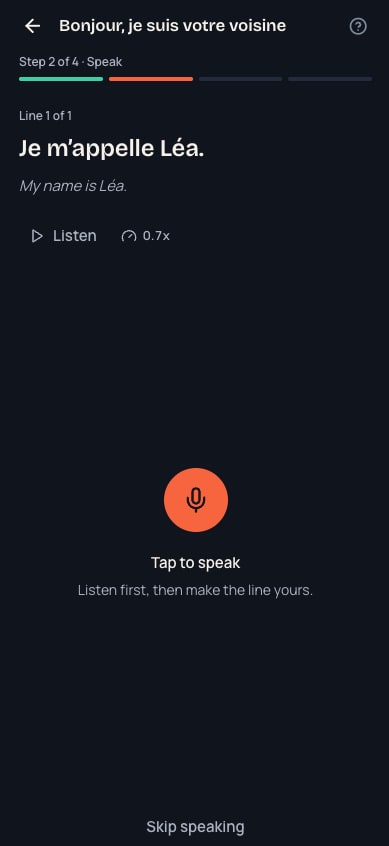
Shadow the same lines and get guided pronunciation feedback.
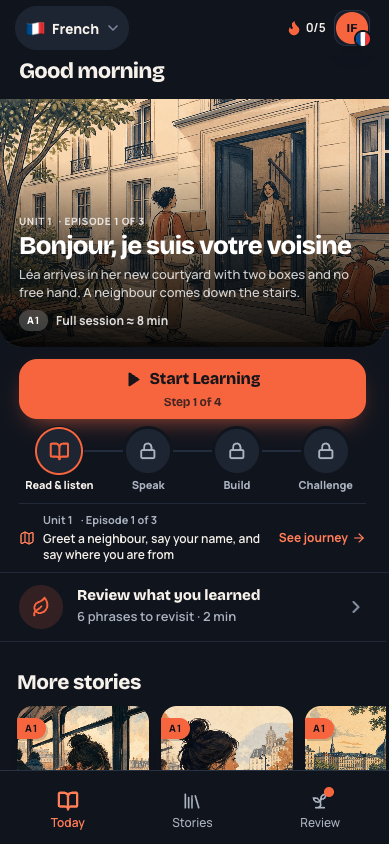
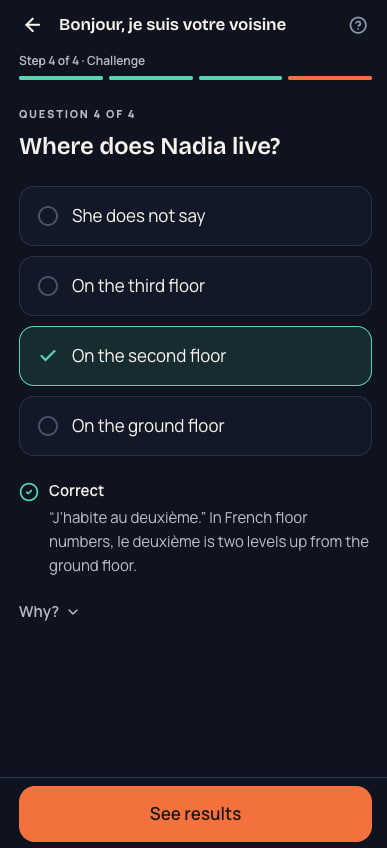
Your path stays visible. The app tracks stories finished, vocabulary growth, and speaking reps.
Start a story session
Your story, ready when you are.
Read → Listen → Speak → Review
Built-in review
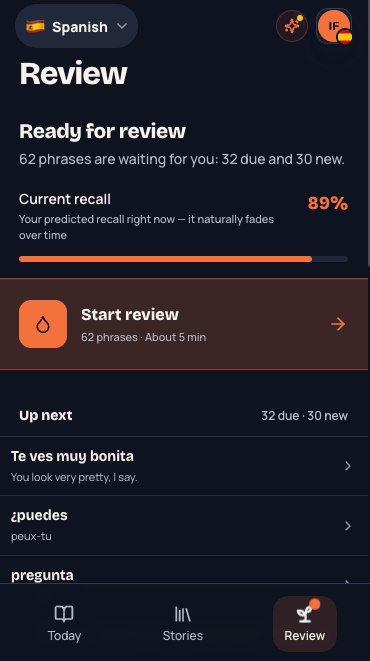
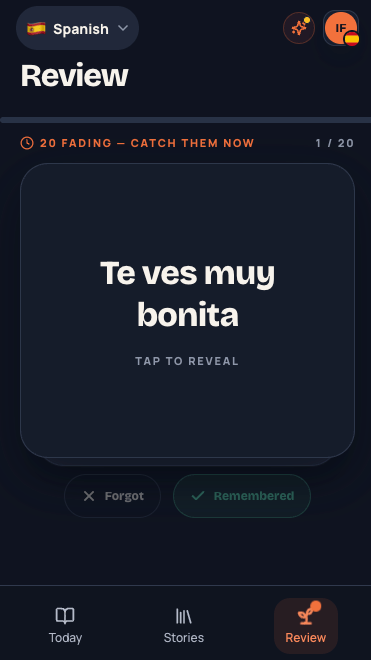
MeloLingua brings back phrases from your stories when they need attention, so review stays connected to a scene you already understand.


Why story-first works
MeloLingua's sessions follow the CEFR's action-oriented approach and research on extensive reading: understand meaningful messages first, then reuse the same lines when you speak.
Trusted by daily learners
Read verified Trustpilot reviews from learners using stories for language practice.
“What I like most is that when I click on a word, I don't just get the translation. I also get an example and some grammar context, which helps me understand why and how the word is used.”
“Short stories makes vocabulary much easier to remember, especially with the speaking practice.”
“Here it feels a bit different because you learn with short stories and real situations, not just random words all the time.”
Written by our language team · How we write comparisons · Research & statistics
These excerpts come from individual verified five-star Trustpilot reviews and are shown as published. Each card links to its original review. The stars describe each featured review, not MeloLingua’s aggregate TrustScore. See every review on Trustpilot.
Pick your language
The app teaches 12 languages; on the web, MeloLingua publishes free graded readers in Spanish, French, German, Italian, Korean, and Russian. Choose a library and start without an account.
Prefer another support language?
Spanish and German readers get the same graded stories with the translations, vocabulary help, and quizzes in their own language.
Español
francésalemánitalianoDeutsch
SpanischFranzösischItalienischAnswers
MeloLingua is a story-based language learning app that keeps reading, listening, vocabulary support, and speaking practice inside the same level-matched story session. It supports 12 target languages in the app and publishes free graded web readers for Spanish, French, German, Italian, Korean, Russian.
MeloLingua works in three simple steps: (1) Listen to a short story while following synchronized text, (2) Learn by tapping words for contextual meaning support, and (3) Speak lines aloud with guided pronunciation feedback. Applied linguistics summaries often find stronger vocabulary recall when words are learned in understood stories versus isolated drills — see our story-based learning research summary for sources and limits.
You can learn 12 languages with MeloLingua: Spanish, French, German, Italian, Portuguese, English, Dutch, Polish, Russian, Japanese, Korean, Turkish. Free graded web readers currently cover Spanish, French, German, Italian, Korean, and Russian. Spanish, French, German, and Italian extend from A1 to B2; Korean and Russian currently focus on A1 and A2.
Yes. Every graded story on melolingua.com is free to browse, with no signup or card. The app is optional and adds personalized daily stories, a structured learning path, guided speaking, and progress tracking. The app includes a free tier. Premium unlocks more practice; reference prices are $11.90 monthly or $69 yearly. The exact local price is shown before purchase.
Story-based language learning is an approach rooted in Stephen Krashen's comprehensible input hypothesis, which states that we acquire language when we understand messages slightly above our current level. Instead of memorizing isolated vocabulary lists or grammar rules, learners absorb language naturally by engaging with compelling narratives. Published reading-intervention work often reports faster comprehension gains than drill-only classrooms; retention ranges vary by study — we summarize what is safe to claim in our 2026 statistics guide.
MeloLingua keeps read, listen, and speak on the same story scene—instead of isolated gamified drills. Duolingo focuses on short exercises and daily streaks. See our guide to the best Duolingo alternatives for a broader comparison of apps, methods, and trade-offs.
About the method
MeloLingua supports 12 target languages in the app and publishes free graded web readers for Spanish, French, German, Italian, Korean, Russian. Reading paths pair narration, meaning support, and pronunciation practice on lines from the same stories.
Explore the comprehensible-input method, review the story-learning research, or compare tools below.